Special Issue of Molecules seeks to explore emerging topics and trends in isotopic techniques and their application to food science from instrumentation, measurement, data‑analysis to novel applications.
Journal: Molecules
Special Issue: Isotopic Techniques for Food Science
Special Issue Editor: Prof. dr. Nives Ogrinc, dr. Federica Camin
Deadline: 29 February 2020
Administration for Food Safety, Veterinary and Plant Protection nominated ORG-O2 department group to be the official laboratory for performing stable isotope analyses of food samples.
On 9.9.2019 Organic biogeochemistry group (ORG-O2) received the official nomination as the laboratory for the official analysis of stable isotopes in food samples by the Administration of the Republic of Slovenia for Food Safety, Veterinary and Plant Protection, Ministry of Agriculture, Forestry and Food. It comes on the back of the laboratory receiving accreditation certificate No. LP-090 with the new extended scope for methods in the field of stable isotope analysis of light elements using mass spectrometry. Accreditation is given only to laboratories that apply rigid standards of quality in day-to-day operations, demonstrate continued accuracy in the performance of proficiency testing, and pass a rigorous on-site laboratory survey. The Laboratory has earned the designation of an official laboratory as a result of a long-term commitment to providing excellence in analytical measurements. Congratulations!
Students from Jožef Stefan International Posgraduate School and Biotechnical Faculty, University of Ljubljana were involved with Jata Emona in the project: FrAPI: Funcional suplements in food and feed: Antioxidation Potencial and the Source that was concluded in July 2019. The main results can be summarized as follows:
determination of Antioksidative Potencial (AOP) in various samples: in onion samples, dietary supplements made from algae (different species), in fresh laboratory-grown algae (chlorella), tannins and hydrolysates of egg membranes;
development of a rapid method for AOP (microtiter plates);
chlorella and its use for cleaning wastewater;
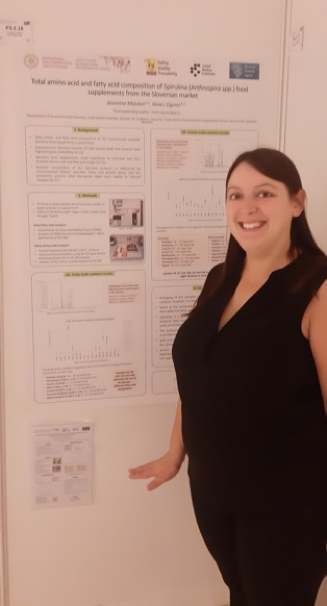
characterization of algae dietary supplements on the Slovenian market;
development of new products from eggshell residues: creams, dietary supplements for pets.
The project was financially supported by Slovenian and EU Social Founds.
N. Ogrinc attended the international fair AGRA in Gornja Radgona on August 28 2019 and presented the future of ISO-FOOD “ISO-FOOD Chair – New challenges”.
The past few years have witnessed a resurgence in demand for and the development of methods and techniques for assuring the quality, authenticity, and safety of food. Much of this need is born out of major food scandals, globalisation, and the increasing complexity of the food supply chain. Fortunately, this has coincided with significant advances in instrumentation, where isotopic and other techniques play a significant role. Recently The ERA Chair ISO-FOOD for isotopic techniques in food quality safety and traceability, Jožef Stefan Institute, Slovenia organised the first ISO-FOOD International Symposium on Isotopic and Other Techniques in Food Safety and Quality held in Portorož, Slovenia (1-3 April 2019). It aimed to highlight recent advances in food safety and quality and to explore the opportunities and challenges ahead.
This special issue of Food and Chemical Toxicology FCT (invites you to join contributors from the ISOFOOD2019Symposium to publish your work (original or review papers) to the peer-reviewed Special Issue on Advances Isotopic and Other Techniques in Food Safety and Quality. The issue will focus on food authenticity and traceability, food safety and quality, foodomics, nanotoxicology, metrology and food databases and semantics.
Submission deadline: September 30 2019
To submit a paper to the special issue, please be sure to select “VSI: ISOFOOD 2019”as the article type.
In the framework of the ERA Chair ISO-FOOD, the Department of Environmental Science, as of 1.4.2019, obtained the Accreditation certificate LP-090 with a new extended scope for methods in the field of stable isotope analysis of light elements more precisely in the determination of the ratios of stable carbon isotopes (13C/12C) in ethanol, and oxygen (18O/16O) in water of foodstuff using mass spectrometry. Accreditation is an important acquisition for the Department and for the Jožef Stefan Institute, since it will strengthen our role in the national metrology system and enable us to enter into the new international projects in the field of food traceability and authenticity.
Tome received the “Best Young Scientist” award for 2018 from the Macedonian president. He was recognized as an extremely talented young scientist with great capacities, knowledge and experience in the scientific and research work. More information »
We would like to offer a big “Congratulations!” to Prof Barbara Koroušić Seljak this year’s The Young Academy of Slovenia Mentor of the Year Award 2018 winner.
Prof Barbara Koroušić Seljak from the Computer Sciences Department, Jožef Stefan Institute collaborates closely with the Department of Environmental Sciences and is a valued member of the ISO-FOOD ERA Chair Team. Prof Barbara Koroušić Seljak was mentor to ISO-FOOD’s doctoral student Tome Eftimov who in January 2018 defended his thesis entitled “Statistical data analysis and natural language processing for nutrition science”.
The Young Academy of Slovenia Mentor of the Year Award 2018 awards recognizes outstanding mentors who have demonstrated a longstanding commitment to student success and development. A good mentor is one who effectively advises, guides, and inspires his/her students throughout their research training, while helping them to navigate obstacles, whether personal, professional, or academic. This year’s deserved winner is Barbara Koroušić Seljak from the Computer Sciences Department, Jožef Stefan Institute. Prof Barbara Koroušić Seljak works closely with of the Department of Environmental Sciences, a valued member of ERA Chair ISO-FOOD Team and mentor to Dr Tome Eftimov who as an ISO-FOOD funded doctoral student in January 2018 successfully defended his thesis entitled “Statistical data analysis and natural language processing for nutrition science”. Tome Eftimov currently works as a Postdoctoral Research Fellow at the Centre for Population Health Sciences, Stanford University, USA. As well as an outstanding mentor, Prof Barbara Koroušić Seljak is an accomplished researcher in her own right, and has made significant contributions in real-time and embedded computer systems and statistics, including topics such as evolutionary computation, natural language processing, machine learning, and data analysis in relation to public and clinical nutrition, and nutrition science.
We use cookies to ensure that we give you the best experience on our website. If you continue to use this site we will assume that you are happy with it.Agree





 n the framework of the ERA Chair ISO-FOOD, the Department of E
 Tome received the “Best Young Scientist” award for 2018 from the Macedonian president. He was recognized as an extremely talented young scientist with great capacities, knowledge and experience in the scientific and research work.